
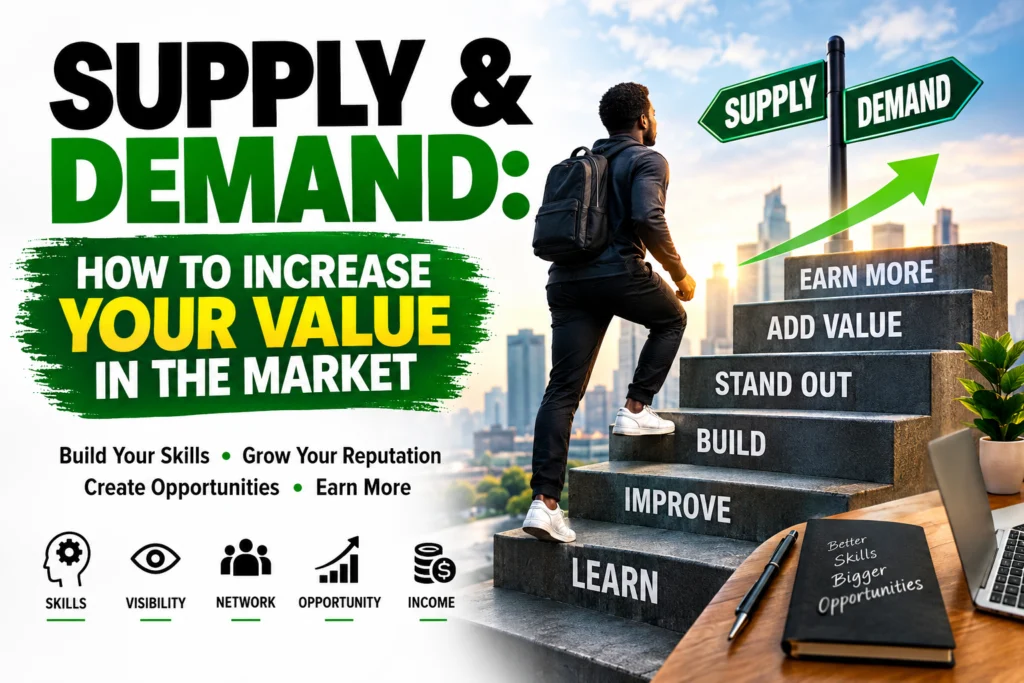
The open market does not simply reward people because they want to earn more money.
It rewards value.
Whether you are an employee, freelancer, entrepreneur, content creator, consultant, salesperson, developer, designer, or business owner, the same basic principle continues to operate:
When people recognize the value you provide, demand for your skills, products, services, or ideas can increase.
This is where the economic principle of supply and demand becomes relevant to everyday life.
You may have a great skill, but if nobody knows about it, your opportunities can remain limited.
You may have a good product, but if it does not solve a real problem, customers may not be interested.
You may have knowledge, but if you never develop it, communicate it, or put it into practice, that knowledge may have little economic value.
The modern marketplace is increasingly connected. Your potential customers, employers, partners, and audiences may be anywhere in the world.
So the question is not simply:
“How can I make more money?”
A better question is:
“How can I become more valuable, make that value visible, and solve problems that people are willing to pay for?”
What Does Supply and Demand Mean?
In economics, supply refers to how much of a product or service is available, while demand refers to how much people want or need it.
- When demand is high and supply is limited, prices can increase.
- When supply is abundant and demand is low, prices generally face downward pressure.
The same principle can provide a useful way of thinking about your career and business.
Imagine that 10,000 people can perform exactly the same basic task, while only a small number of people possess a specialized skill that businesses urgently need.
The specialized skill may command greater economic value because fewer people can provide it while demand remains strong.
This does not mean that every rare skill automatically becomes highly valuable. The skill must also solve a meaningful problem.
That is the important connection:
Value is created when your ability meets a real need.
Your Skills Are Part of Your Personal Supply
Think of your skills as the supply you bring into the marketplace.
Your supply can include:
- Technical skills
- Communication
- Sales ability
- Leadership
- Programming
- Design
- Writing
- Marketing
- Project management
- Data analysis
- Customer service
- Problem-solving
- Industry knowledge
- Creativity
- Research
- Professional experience
The more useful skills you develop, the more problems you may be capable of solving.
However, there is an important distinction between having a skill and being valuable in the marketplace.
A skill becomes economically useful when it can produce a result that someone needs.
| The skill | What it becomes when applied |
|---|---|
| Knowing how to use graphic design software | A service: creating a professional brand identity that helps a business communicate with customers |
| Knowing how to write | A service: creating persuasive, useful content that attracts and educates a target audience |
| Knowing how to code | A business solution: building a functioning website that helps a company generate leads, sell products, or serve customers |
The marketplace generally cares about the result.
Don’t Just Build Skills — Build Useful Skills
One of the biggest mistakes people make is learning skills without considering where those skills can be applied.
Learning is valuable, but learning should eventually connect to application.
Before investing months into a new skill, ask yourself:
- What problem does this skill solve?
- Who has this problem?
- How serious is the problem?
- Are people or businesses already paying to solve it?
- Can I become good enough to provide a useful solution?
These questions help turn random learning into strategic skill development.
For example, instead of saying:
“I want to learn digital marketing.”
You can think more specifically:
“I want to learn how to help small businesses generate customers through search engines, social media, email marketing, and content.”
The second approach connects the skill to a problem.
The Market Rewards Value, Not Just Effort
Working hard is important.
But effort alone does not automatically create economic value.
Two people can work for ten hours and produce completely different results.
One person may spend ten hours performing a task that creates little measurable value.
Another person may spend two hours solving a problem that saves a company thousands of dollars.
The difference is not necessarily who worked harder. It is the value of the problem being solved and the result being produced.
This is why developing valuable skills matters.
Instead of asking only:
“How hard am I working?”
Ask:
“What valuable result am I producing?”
That question can change the way you approach your career.
Visibility Matters in an Open Market
Having value is one part of the equation.
Being discoverable is another.
You can be highly skilled and still struggle to find opportunities if nobody knows what you can do. This is why visibility has become extremely important.
Your visibility can come from:
- A professional website
- A portfolio
- Social media
- Blog articles
- YouTube
- Online communities
- Networking
- Referrals
- Public projects
- Case studies
- Testimonials
- Professional certifications
- Speaking or educational content
Visibility does not mean constantly showing off.
It means making it easier for the right people to understand:
- Who you are
- What you can do
- Who you help
- What problems you can solve
- What results you can produce
Build a Personal Brand Around Value
Personal branding is often misunderstood.
It is not simply having a nice photograph, logo, or social media bio.
Your personal brand is largely shaped by what people consistently associate with your name.
- If you repeatedly publish useful information about technology, people may begin to associate you with technology.
- If you consistently demonstrate expertise in marketing, people may associate you with marketing.
- If you regularly solve business problems for clients, your reputation can begin to reflect that ability.
This is why consistency matters.
You are effectively building a public record of your knowledge, work, experience, and contribution.
Humility Is a Competitive Advantage
Humility, service, discipline, consistency, and exposure may sound simple, but they matter because markets are built around relationships.
Nobody knows everything.
A person who is willing to learn from others can continue improving. A person who refuses feedback can eventually become disconnected from changing customer needs, technology, and market conditions.
Humility does not mean thinking less of yourself.
It means being willing to recognize that there is always something to learn.
- Ask questions.
- Listen to customers.
- Study competitors.
- Learn from experienced professionals.
- Accept constructive criticism.
- Update your skills.
The marketplace changes constantly, and your ability to adapt can matter as much as your initial skill.
Service Creates Opportunity
One of the simplest ways to become more valuable is to focus on service.
| Instead of thinking… | Try thinking… |
|---|---|
| “What can I sell?” | “What problem can I solve?” |
| “I want customers.” | “I want to understand what my customers need and provide a useful solution.” |
| “I want a better job.” | “What skills can I develop that make me more useful to an employer?” |
This change in perspective can influence the way you approach business and employment.
Businesses exist because they solve problems.
Employees are hired because they perform useful functions.
Freelancers are paid because clients need specific outcomes.
Entrepreneurs identify problems and create solutions.
The common denominator is value.
Why Consistency Matters More Than Motivation
Motivation can help you start.
Consistency helps you continue.
You may not feel motivated every day to learn a skill, publish content, contact customers, improve your portfolio, or build your business. That is normal.
Successful development usually comes from repeated action rather than occasional bursts of enthusiasm.
- Publishing one useful article every few weeks can eventually create a substantial library of content.
- Improving one skill every month can produce significant development over several years.
- Building one professional relationship at a time can eventually create a powerful network.
Small actions become significant when repeated consistently.
Exposure Can Increase Your Opportunities
You cannot receive opportunities that cannot find you.
This is why exposure matters.
Imagine two professionals with similar abilities.
One keeps everything private.
The other publishes useful work, maintains a portfolio, participates in professional communities, networks with people, and demonstrates their expertise publicly.
Their skills may be similar, but the second person has created more opportunities for people to discover their work.
Exposure does not guarantee success. But it can increase the number of opportunities available for your skills to be noticed.
The goal is not to become famous.
The goal is to become discoverable by the right people.
Stop Thinking in Silos
The modern economy is interconnected.
- A developer may need marketing.
- A marketer may need design.
- A business owner may need technology.
- A content creator may need video editing.
- A freelancer may need sales skills.
- A company may need someone who understands both technology and business.
This is why combining skills can be powerful. For example:
- Technology + Communication
- Design + Marketing
- Writing + SEO
- Programming + Business
- Sales + Industry Knowledge
- Finance + Data Analysis
- Project Management + Technology
Instead of becoming average at ten unrelated things, consider developing a strong primary skill and then adding complementary skills that make you more useful.
Create Your Own Demand
You cannot completely control market demand.
But you can influence how your skills are positioned.
Suppose you simply say:
“I am a web developer.”
That tells people your general profession.
Now imagine saying:
“I build fast, mobile-friendly websites that help small businesses establish an online presence and generate customer inquiries.”
The second statement communicates a problem and a solution.
This is positioning. You are making it easier for the market to understand your value.
Don’t Confuse Price With Value
A high price does not automatically mean high value.
Likewise, a low price does not necessarily mean poor quality.
Price depends on many factors, including:
- Demand
- Competition
- Skill level
- Experience
- Brand reputation
- Customer expectations
- Market conditions
- Location
- Complexity
- Urgency
- Results
- Availability
The important lesson is that you should understand the market before deciding what your work is worth.
- Research what customers need.
- Study competitors.
- Understand your target audience.
- Look at the results you can realistically deliver.
- Then position your offer accordingly.
The Internet Has Changed the Marketplace
The internet has dramatically reduced geographical barriers for many types of work.
- A person can create content for an international audience.
- A freelancer can work with clients in another country.
- A developer can build software for users around the world.
- A business can sell products online.
- A professional can build a reputation through educational content.
This creates both opportunity and competition.
You are no longer competing only with people in your immediate environment. Depending on your industry, you may be competing in a global marketplace.
That makes continuous learning increasingly important.
How to Increase Your Personal Market Value
Here are practical steps you can take.
1. Identify a valuable problem
Find a problem that people or businesses genuinely need solved.
2. Develop the necessary skill
Learn the knowledge and practical abilities required to solve that problem.
3. Practice
Do not stop at theory.
- Build projects.
- Work on real problems.
- Create examples of your work.
4. Document your work
Create a portfolio, case study, website, or professional profile showing what you can do.
5. Improve your communication
Being able to explain your value clearly is an important professional skill.
6. Increase your visibility
Publish useful content, network, participate in communities, and make your work discoverable.
7. Build relationships
Opportunities often come through people who know, trust, or recommend you.
8. Ask for feedback
Find out what customers, employers, colleagues, or mentors think you could improve.
9. Keep learning
Technology, customer preferences, and industries change. Your skills must evolve with them.
10. Focus on results
Whenever possible, demonstrate what your work actually accomplished.
A Simple Formula for Building More Value
You can think about your professional growth using this simple framework:
Skill + Problem Solving + Visibility + Trust + Consistency = Greater Opportunity
- Skill gives you capability.
- Problem solving gives that capability a purpose.
- Visibility helps people discover you.
- Trust makes people comfortable working with you.
- Consistency allows your reputation and experience to compound over time.
There is no guaranteed formula for becoming wealthy. But these principles can help you become more useful and better positioned to take advantage of legitimate opportunities.
Supply and Demand Applies to Careers Too
You do not have to own a company to participate in the market.
Employees are also part of the labor market.
Your employer has a demand for certain capabilities. You supply those capabilities through your time, knowledge, experience, and skills.
This means career development should involve more than simply waiting for promotions.
Ask yourself:
- What skills are becoming more useful in my industry?
- What problems are employers struggling to solve?
- What can I learn that complements my existing abilities?
- Can I demonstrate those skills through projects or measurable results?
These questions can help you make more deliberate career decisions.
Don’t Chase Every Trend
An open market creates opportunities, but it also creates noise.
Every year there is a new business trend, investment trend, technology trend, social media platform, or online opportunity promising fast results.
Be careful.
A trending opportunity is not automatically a good opportunity for you.
Before committing your time or money, investigate:
- Who is behind it?
- What exactly is being offered?
- How does the business generate revenue?
- What are the risks?
- What evidence supports the claims?
- What do independent sources say?
- What happens if the opportunity disappears?
A strong financial mindset includes skepticism.
Do not allow the desire for quick money to replace proper research.
Think Long Term
The goal should not always be to make money as quickly as possible.
Sometimes the better long-term investment is building something that increases your ability to create value repeatedly.
That could be:
- A professional skill
- A business
- A portfolio
- A website
- A personal brand
- A customer network
- A valuable digital product
- Industry experience
- Professional relationships
These assets can potentially continue producing opportunities after the initial effort.
The key is to build something that becomes more valuable because of your accumulated knowledge, reputation, experience, or relationships.
Final Thoughts: Think and Serve to Grow
The central message of this article can be summarized simply:
Do not wait for the market to discover your value. Develop it, demonstrate it, communicate it, and consistently use it to solve real problems.
Supply and demand is not only an economic concept found in textbooks.
It can also be a useful framework for thinking about your career, business, skills, and personal development.
- If your skills are useful, continue improving them.
- If people do not know about your work, improve your visibility.
- If your offer is not attracting interest, study the market.
- If customers are not responding, understand their problems more deeply.
- If your industry is changing, adapt.
And if you want to create more opportunities, focus on becoming someone who can consistently provide something valuable.
The open market does not guarantee success to everyone.
But it creates opportunities for people who are willing to learn, serve, adapt, communicate their value, and keep improving.
Think. Learn. Serve. Build. Stay consistent.
Because when you solve meaningful problems and make your value visible, you give the market a reason to notice you.
Frequently Asked Questions
What is supply and demand?
Supply refers to the amount of a product or service available in a market, while demand refers to the amount consumers want or need. Changes in supply and demand can influence prices and market activity.
How does supply and demand affect income?
Income can be influenced by the demand for particular skills and the availability of people who can provide those skills. Other factors such as experience, location, industry, performance, and economic conditions also matter.
How can I increase my value in the job market?
Develop useful skills, gain practical experience, solve meaningful problems, communicate your abilities clearly, build a professional reputation, and keep learning as your industry changes.
Does having a rare skill guarantee higher income?
No. Scarcity alone does not guarantee high income. The skill must also provide meaningful value and have sufficient demand in the relevant market.
Why is personal branding important?
Personal branding can help people understand what you do, what you know, and what problems you can solve. A clear and consistent professional presence can make your expertise easier to discover.
Can supply and demand apply to freelancing?
Yes. Freelancers operate in a market where clients demand particular services and freelancers supply those services. Demand, competition, expertise, reputation, and the value of the outcome can all influence opportunities and pricing.
What is the most important lesson about supply and demand?
Focus on the intersection between what you can do and what people genuinely need. Developing useful skills and connecting them to real problems can improve your position in the marketplace.
